Five players, an uncommon balance
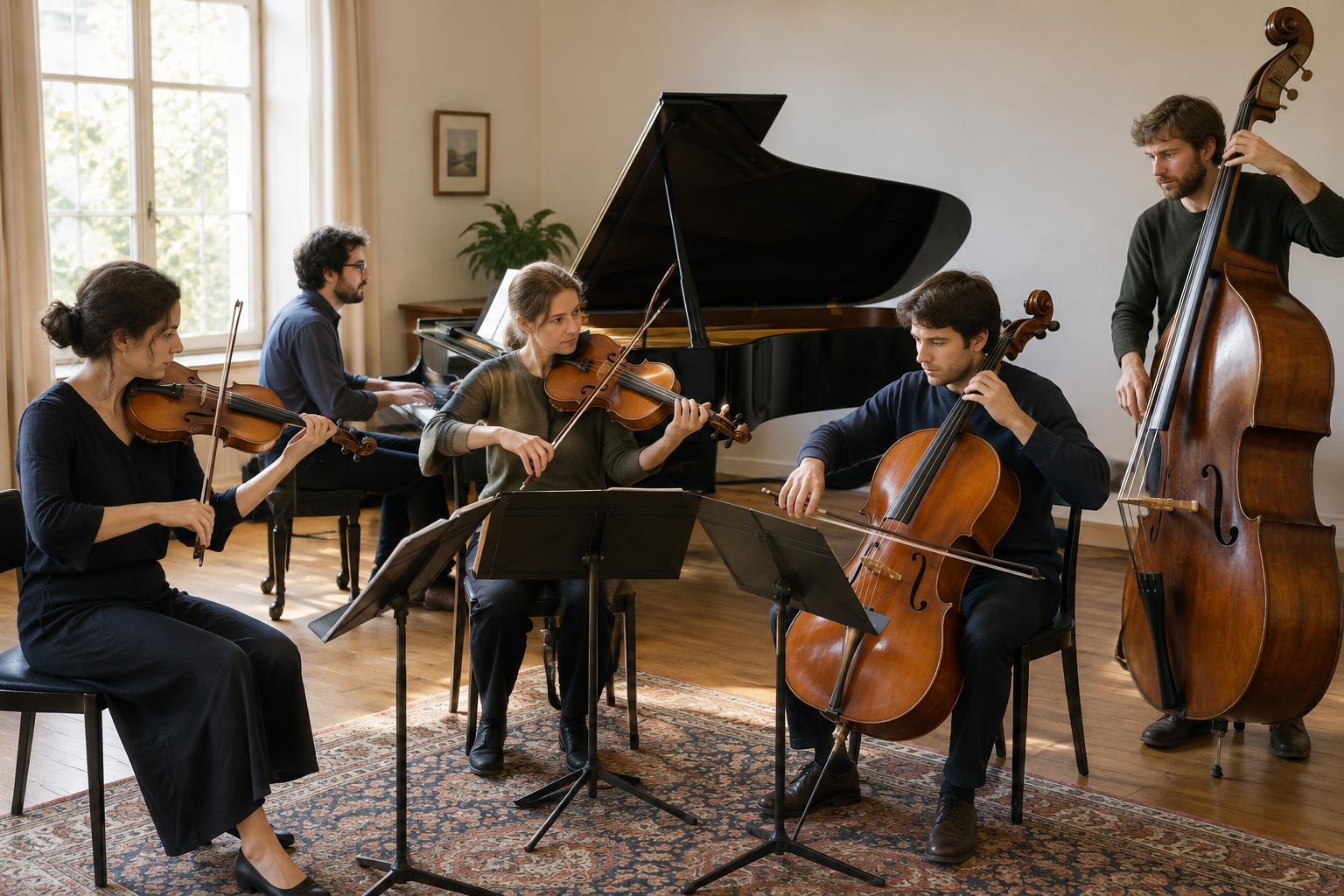
Schubert’s Piano Quintet in A major, widely known as the “Trout” Quintet, uses piano, violin, viola, cello and double bass. That lineup changes the sound you might expect from a piano quintet: instead of two violins, there is one violin and a double bass beneath the cello. The extra depth can make the ensemble feel spacious without making it sound like a small orchestra.
On a first listen, try following the lowest notes. The double bass often gives the music a firm floor while the cello has room to move above it. Then notice how the piano fits around the strings. It can supply a bright rhythmic pulse, trade short phrases with them or take a more prominent melodic role. The pleasure of this piece lies partly in hearing those roles shift without losing the sense that five musicians are playing together.
The opening movement: listen for exchanges
The first movement offers a good way to learn the ensemble’s voices. Rather than trying to remember every melody, listen for a musical idea as it passes between piano and strings. A phrase may begin with one player, receive an answer from another and return in a changed setting. Even when the full group is active, individual lines remain worth following.
Pay attention to contrast, too. Fuller passages make the quintet sound energetic and expansive; thinner passages let a small detail come forward. If a section seems familiar when it returns, ask what has changed around it. Is the piano more conspicuous? Is the bass supporting the same idea differently? These questions give you something concrete to hear without requiring a score or knowledge of musical form.
Two middle movements, two kinds of motion
The second movement, an Andante, invites a different sort of attention. Listen to the length of each phrase and the way one instrument makes space for the next. You need not decide where every formal section begins or ends; the contrast between sustained lines and more active accompaniment is enough to provide a path through the movement.
The third movement is a scherzo, and its quick motion makes rhythm easier to notice. Listen for the group’s shared accents and for the change of character in its contrasting middle passage. When the opening material returns, it can feel familiar even if you have not consciously memorized it. Hearing the Andante and scherzo side by side also shows how the same five players can create distinct moods simply by changing pace, articulation and texture.
Why it is called the “Trout” Quintet
The nickname comes from the fourth movement, a set of variations on the melody of Schubert’s song “Die Forelle,” or “The Trout.” You do not need to know the song to follow what happens. First listen for a clear statement of the tune. As the movement continues, its outline remains a point of reference while the music around it changes.
For a practical listening exercise, choose one element to track through the variations: the melody, the instrument that carries it or the character of the accompaniment. Sometimes the tune is easy to recognize; at other moments, a change in register or decoration draws your attention elsewhere. A variation movement is not simply the same passage repeated. It lets you hear how many different textures and personalities can grow from one musical idea.
The song has words and a story, but the quintet’s variations do not need to be heard as a literal retelling. Treat the song melody as musical material that the five players reshape together. That approach keeps the focus on what you can hear in the chamber ensemble itself.
The finale and a useful second listen
The fifth movement brings the work to a lively close. By now, you may have a clearer sense of what each instrument contributes. Listen for quick changes between passages led by a single voice and passages in which the ensemble moves as a unit. Notice, too, how the double bass continues to anchor the sound without always demanding attention.
On a second hearing of the whole quintet, follow one player from start to finish. The cello is an especially useful choice: it can support the harmony, join a melody or occupy the space between the bass and higher strings. Then try listening again with your attention on the piano. Changing your focus can make a familiar passage seem new, which is one of the lasting rewards of chamber music.