A chamber work with room to unfold
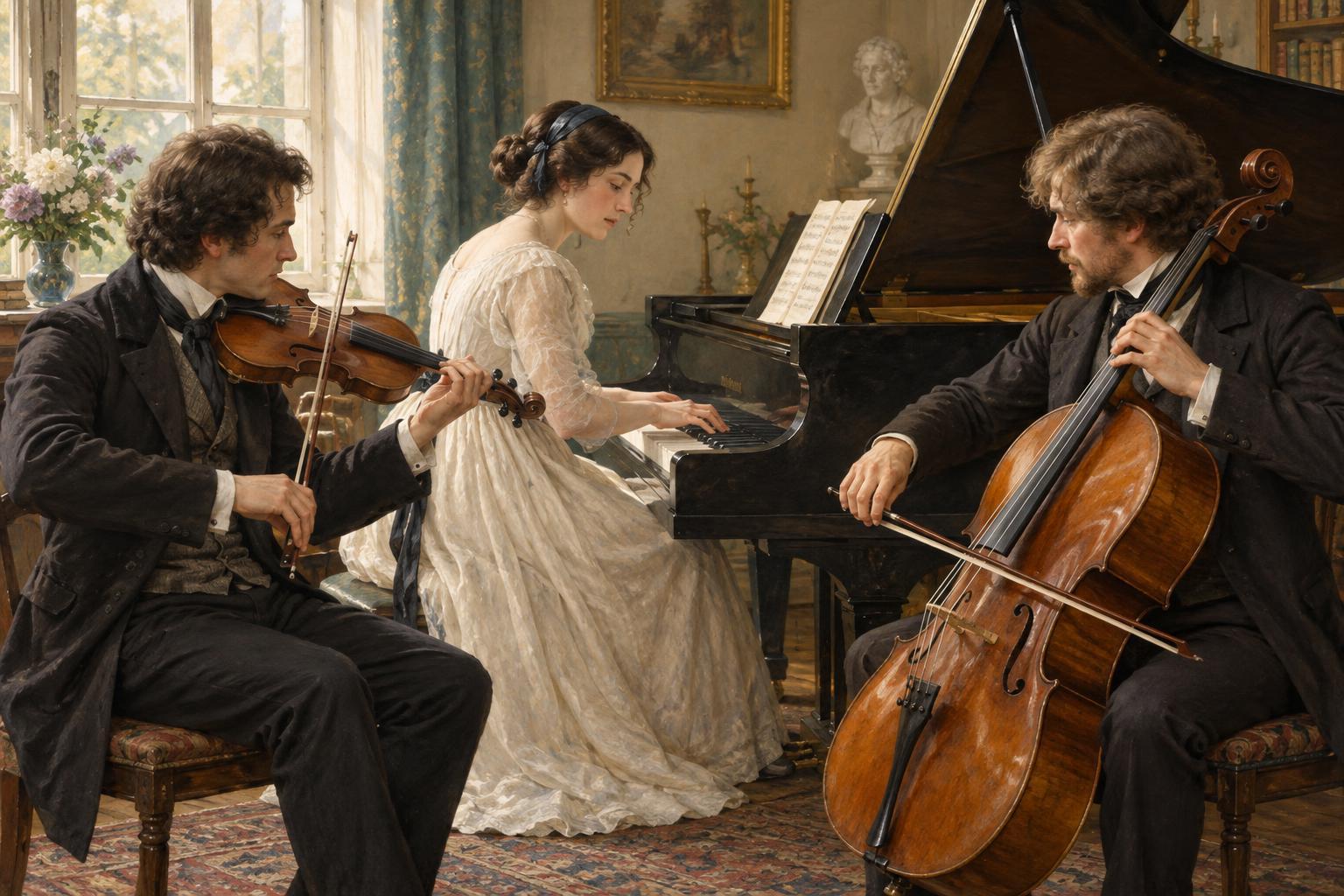
Clara Schumann is often introduced as a pianist and as an interpreter of Robert Schumann’s music. Both roles mattered, but neither accounts for her own compositions. Her Piano Trio in G minor, Op. 17, completed in 1846, offers a particularly rewarding way to hear her as a composer. Written for piano, violin and cello, it gives her melodic ideas more space to develop than a short piano piece or song can provide.
The trio is one of her most substantial surviving works and her only completed piano trio. That does not make it the single key to everything she wrote. Her output also includes a piano concerto, solo piano music, songs and later works for violin and piano. Hearing the trio alongside those pieces makes its mixture of intimacy and ambition easier to appreciate: it uses a familiar chamber ensemble to sustain an argument across four movements without losing the directness of a personal musical thought.
What carries over from the songs and piano pieces
Listeners familiar with Clara Schumann’s songs may recognize the importance of a clearly shaped melodic line. In a song, the piano can prepare, support or answer the singer; in the trio, violin and cello can take turns in those roles. A phrase begun by one instrument may acquire a different character when another continues it. Listen not only for which instrument has the tune, but also for what the others do while it sings.
Her experience at the keyboard is audible, too, though the piano part is more than a display vehicle. It can provide momentum through flowing figures, establish harmony with firm chords, or step back so a string line can come forward. If you have heard her solo piano music, notice how a gesture that might sound complete under two hands becomes the start of an exchange when three players share it. The trio’s character depends on that exchange, not on treating violin and cello as decoration around the piano.
Following the four movements
The opening Allegro moderato establishes the work’s serious cast while leaving room for contrasting, more lyrical material. Rather than trying to identify every formal boundary on a first hearing, follow the return of recognizable ideas. Notice how changes in texture—a fuller piano passage, a more exposed string line, or a closer dialogue between players—can make familiar material feel newly urgent.
The second movement is a scherzo marked Tempo di menuetto. Its dance character offers a change of pace, but it is not merely a light interruption. Listen for the contrast between more animated passages and moments that feel gentler or more poised. The Andante then invites attention to sustained phrases and to the way the instruments pass expressive weight among themselves. In a performance, a small shift in timing or balance can change how that conversation feels.
The concluding Allegretto brings back a sense of motion and gives the ensemble a chance to gather its threads. You need not hear a single story running through all four movements to find the structure satisfying. Each movement offers a different way for the same three instruments to relate: sometimes one leads, sometimes two answer each other, and sometimes all three contribute to a shared pulse.
Placing Op. 17 in her output
Op. 17 sits between the early virtuoso writing associated with Clara Schumann’s career as a young pianist and the smaller-scale works she composed later. That position is useful context, not a neat account of artistic progress. A concerto, a song and a trio ask different things of a composer. What this trio makes especially clear is her ability to sustain contrast and continuity over a larger chamber-music span.
For a focused listening comparison, pair the trio with one of her songs, then with a short solo piano work or one of her later romances for violin and piano. Ask how she introduces a melody, what happens beneath it, and how an accompanying part becomes an active voice. Those questions bring the works into conversation without requiring them to sound alike.
It is also worth hearing Op. 17 on its own terms. Its value does not depend on proving that Clara Schumann composed despite every demand on her time, or on measuring it against a work by her husband. The trio offers four varied movements and a rich set of relationships among three players. Attending to those relationships is a good way to discover the composer’s voice for yourself.