A familiar ensemble, an open-ended form
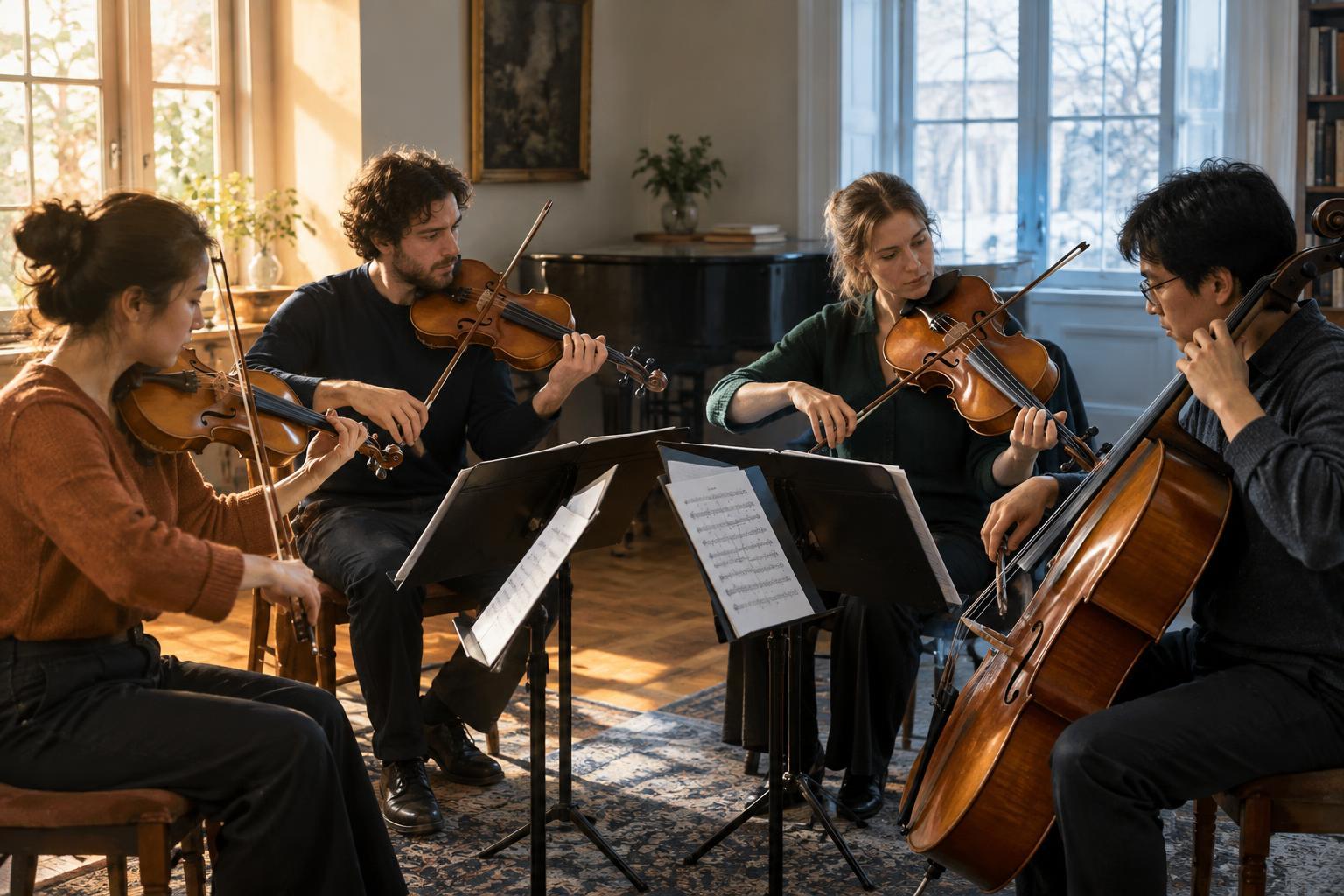
Two violins, a viola and a cello make up a string quartet. With only four players, a listener can often follow individual lines as well as the sound they create together. That clarity makes the quartets by Claude Debussy and Maurice Ravel especially rewarding: both composers use the same compact ensemble to produce a surprising range of textures.
Debussy’s String Quartet in G minor and Ravel’s String Quartet in F major each have four movements. Both move from an opening movement through a lively second movement and a slower third to an energetic finale. Both also bring back musical ideas across movements. Those similarities offer a useful map, but they need not turn listening into a search for identical passages. The pleasure lies in hearing how differently each composer handles a recognizable plan.
Debussy: themes that change as they travel
At the start of Debussy’s quartet, listen for a compact, strongly shaped idea. It gives the opening movement a point of departure, but the music does not simply repeat it in one fixed guise. Its contours and rhythms can be heard in changing surroundings, sometimes prominent and sometimes folded into a busier texture. If you lose track of the theme, follow the exchanges between instruments instead: one player may begin a gesture that another takes in a new direction.
The second movement shifts the emphasis toward pulse and articulation. Plucked notes, known as pizzicato, help create a light, sharply outlined texture alongside bowed playing. In the slow movement, longer phrases give the players more room to shape each line. The finale restores urgency while drawing on material heard earlier. Rather than treating every return as a puzzle to solve, notice how familiar gestures feel altered by their new speed, register or accompaniment.
Ravel: precision with room for surprise
Ravel’s quartet begins more gently. Its opening melody has a clear profile, making it an inviting landmark for a first listen. As the movement unfolds, the players redistribute and reshape ideas, balancing lyrical passages with more animated exchanges. The result can sound carefully proportioned without becoming predictable: the interest is often in the exact moment a melody changes hands or a texture suddenly thins.
Ravel’s second movement also makes memorable use of pizzicato, but it is worth hearing on its own terms rather than as an echo of Debussy. Crisp attacks and shifting accents give it a restless energy. The slow movement offers a different challenge to the ear, moving through delicate, sometimes elusive transitions. In the finale, quick changes of momentum and texture contribute to a sense of agitation. Material from earlier in the quartet helps connect that intensity to what came before.
How to hear the differences
Try listening to the two opening movements back to back. First, pay attention to how each quartet establishes an idea you might recognize later. Then ask what keeps you oriented when that idea is absent: a steady pulse, a distinctive texture, an exchange between players or the shape of a phrase. This approach makes comparison possible without requiring a score or specialist vocabulary.
Next, compare the second movements. In both, plucked strings draw attention, but pizzicato is a playing technique, not a complete description of the music. Listen to which instrument carries the main gesture, how the bowed parts respond and whether the rhythm feels firmly grounded or playfully unsettled. Finally, hear each finale after its own slow movement. The contrast gives the closing energy its particular force.
It is tempting to summarize Debussy as fluid and Ravel as precise. That can be a starting impression, not a rule: Debussy’s quartet has rhythmic bite, and Ravel’s has passages of great softness and flexibility. Hearing both works repeatedly reveals more than a contest of styles. Each shows how four players can make a recurring idea feel new by changing its surroundings and the way it is passed from one instrument to another.