Give each line a different job
When a melody catches your attention, it is natural to follow it as though it were the whole conversation. The bass often works less conspicuously. It may mark a steady pulse, give a phrase somewhere to land, or make a familiar melodic note feel different by changing the harmony beneath it. You do not need to hear every low note to sense that work.
Start by assigning the two lines different jobs in your mind. Let the melody be the voice you follow, and treat the bass as the ground it moves over. As you listen, ask a broad question: does that ground feel settled, or does it seem to be going somewhere? This keeps the melody in view while giving the lower line a place in your attention.
Find the bass before you try to follow it
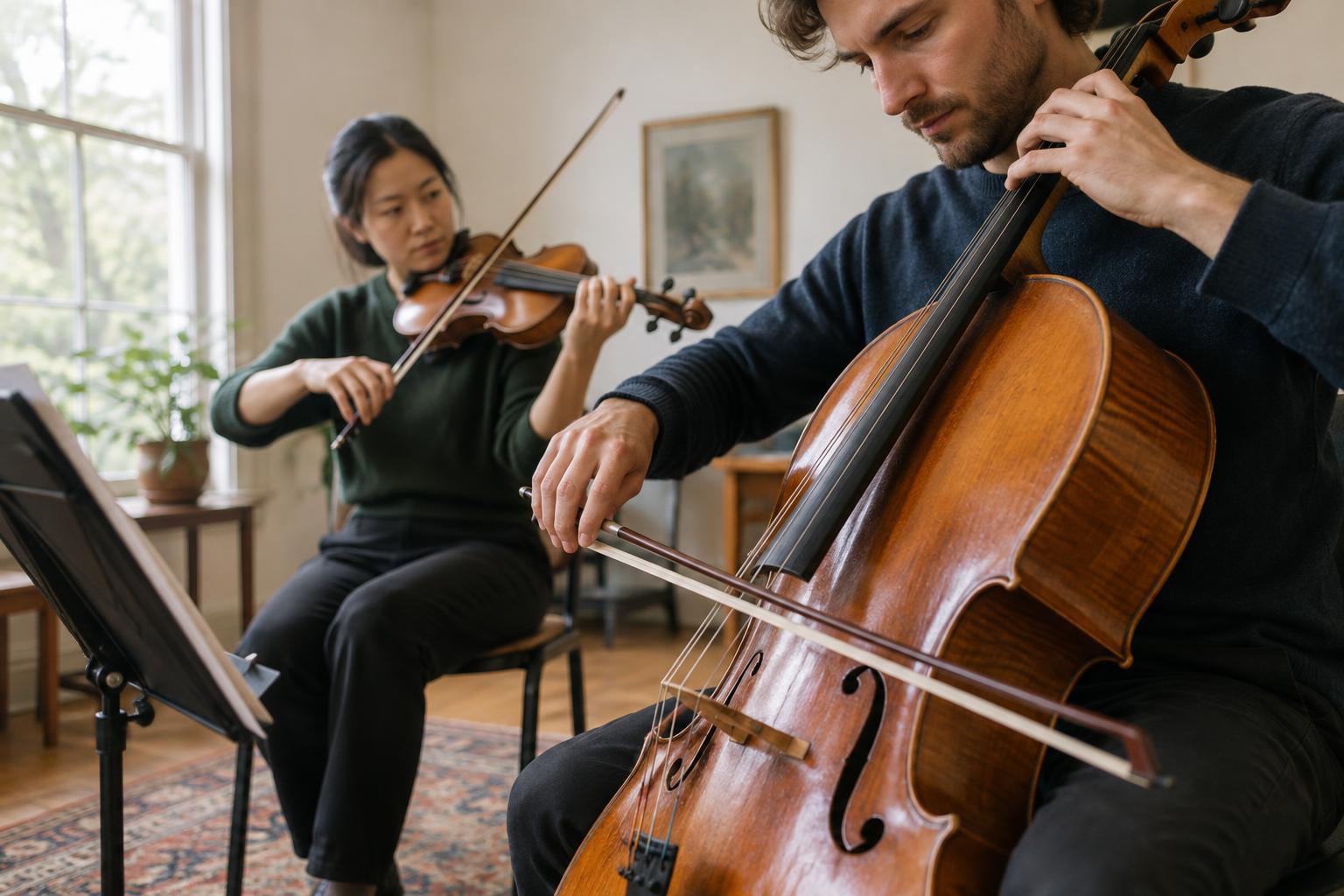
In a string quartet, the cello is a useful first place to listen, though the viola or another instrument may briefly carry the lowest moving line. In a piano trio, low notes may come from the cello, the pianist’s left hand, or both. Wind groups can distribute low-register duties among several instruments. Instead of deciding in advance that one player is always “the bass,” listen for the line that seems to support the others at that moment.
Try listening to a short passage twice. On the first hearing, notice the melody’s general shape: does it rise, fall, pause or repeat? On the second, attend to the lowest clearly audible notes. Do they arrive with a regular beat, move between the melody’s pauses, or hold still while other parts change? Remember one observation, then listen again without trying to keep a running inventory. A few landmarks are more useful than an exhausting note-by-note chase.
Notice what changes when the bass moves
A bass line is especially revealing at the start or end of a phrase. A low note that remains in place can make the music feel anchored even when the melody is active. A sequence of moving low notes may create a sense of travel. When the bass settles after that movement, you may hear a point of arrival without needing to name a chord or identify a key.
Listen, too, for moments when the melody repeats a note or a small figure. If the bass changes underneath it, the repetition may feel fresh, tense or more at rest. This is one way to hear harmony as an event rather than a theory exercise: the upper part seems familiar, but its surroundings have changed. The effect will vary with the music, so let your ears describe it in ordinary words before reaching for technical labels.
Use a small attention loop
Trying to follow two independent lines continuously can be tiring. Instead, use a three-step loop over a brief passage. First, listen mainly to the melody. Next, replay the passage and listen mainly to the bass. Finally, hear it once more and notice just one point where the two lines meet: perhaps they begin together, move in opposite directions, or come to rest at the same time.
If you are at a concert and cannot replay the music, the loop still works on a smaller scale. Spend a few seconds with the melody, shift to the bass for a few seconds, then return to the overall sound. Missing a detail is not a failure. The aim is to notice a relationship, not to pass a test. You may find that the melody becomes easier to follow once you have heard what supports it.
Make room for exceptions
The bass is not always a quiet foundation. A cello can sing a prominent tune while higher instruments provide accompaniment. A low instrument can answer the melody with its own distinct phrase, or pause entirely. When that happens, ask which line your ear treats as the main idea and which line adds context. The roles can change within a single piece.
For practice, choose a passage with a melody you can recognize easily. Follow its shape once, then listen for just three bass events: an entrance, a noticeable move and a stopping point. On the next hearing, keep those events in mind without actively searching for them. Gradually, the bass may become part of how you hear the melody rather than something that pulls you away from it.