Why begin with the Piano Quintet?
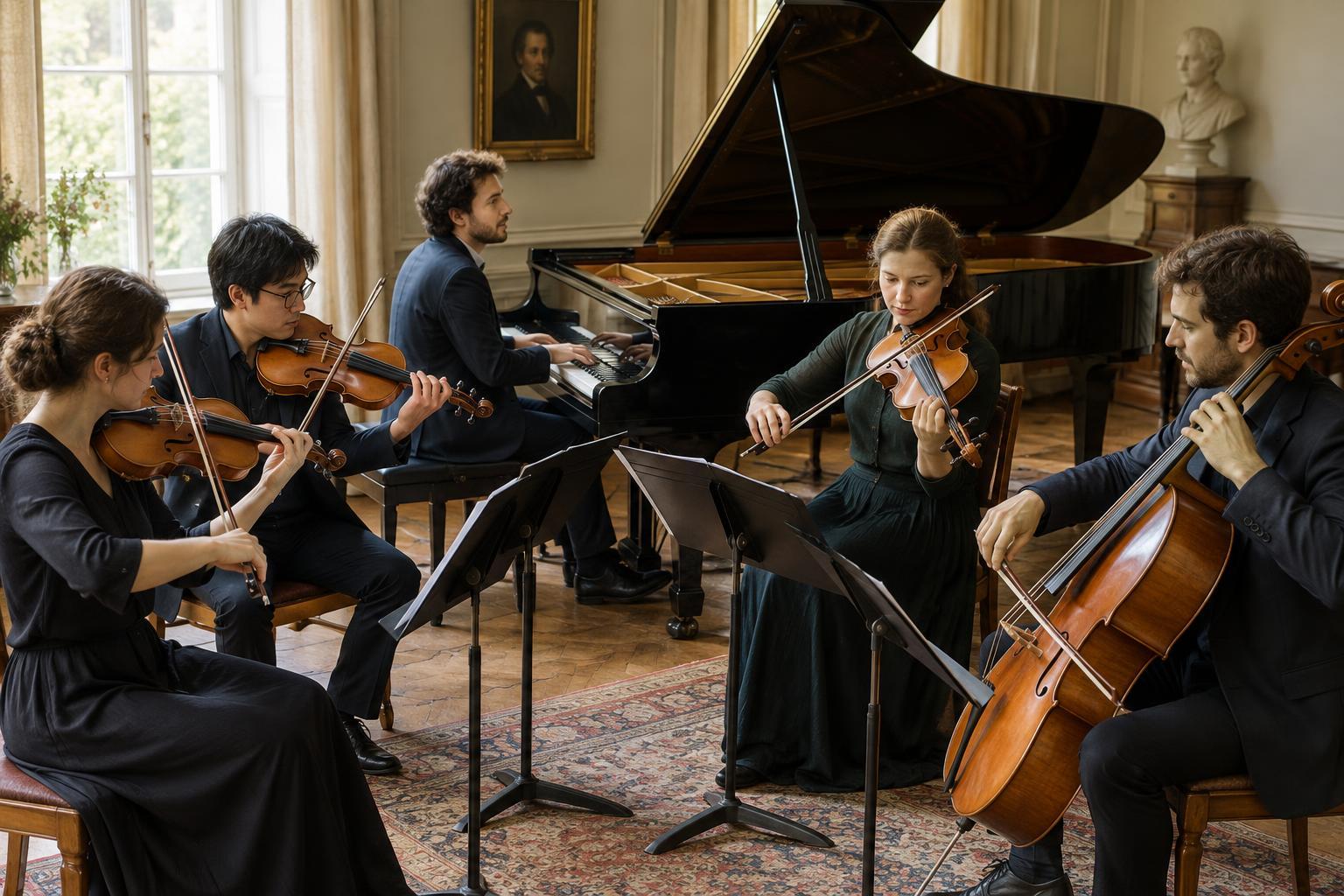
Robert Schumann’s Piano Quintet in E-flat major, Op. 44, makes an inviting entry into his chamber music. Written in 1842, it pairs a piano with a string quartet: two violins, viola and cello. That combination gives Schumann room for both broad, emphatic gestures and exchanges that feel almost conversational. A listener does not need to identify every theme to hear the central question of the piece: how can five distinct instruments sound like one ensemble without losing their individual voices?
The quintet is also a useful introduction because its four movements offer sharply different experiences. The first is expansive and energetic; the second moves with the gravity of a march; the third is quick and playful; and the finale gathers momentum toward a tightly worked conclusion. Listening for those contrasts is enough to give a first hearing a sense of direction.
First movement: energy shared across the ensemble
The opening Allegro brillante announces itself boldly. Piano and strings can sound united in a single, ringing statement, then divide into smaller groups as an idea passes between them. Notice how the piano changes roles: at one moment it gives weight to the whole ensemble, while at another it supplies a flowing background against which a string line stands out. The strings, in turn, do more than accompany a keyboard soloist.
On a first listen, follow the changes in texture rather than trying to memorize the melody. Ask which instrument has your attention and how that focus shifts. When a familiar idea returns, it may feel different because of its setting: louder or softer, more spacious or more urgent. These changes help give the movement its forward drive.
Second movement: a march with changing moods
The slow movement, marked In modo d’una marcia, begins with a measured tread. Its restrained, sombre character contrasts with the brightness of the opening movement, but Schumann does not hold to a single mood throughout. More lyrical passages offer relief, while a more agitated section interrupts the march’s steady pace.
Listen to what happens when the march returns after these contrasts. The basic rhythm remains recognizable, yet the intervening music may change how you hear it. This movement is a good reminder that chamber music can create drama without a story attached: tempo, rhythm, register and the distribution of parts can suggest tension and release on their own.
Scherzo and finale: motion, then connection
The Scherzo: Molto vivace is powered by swift rising and falling figures. Its movement is easy to recognize even if the individual notes fly past. Two contrasting trio sections break up that rush, giving the ear a change of pace and character before the scherzo material returns. Try following the shape of the lines—up, down, pause, restart—rather than attempting to count every beat.
The finale, Allegro ma non troppo, begins with renewed purpose. Themes are exchanged, layered and developed as the five players build toward the close. Near the end, listen for the way Schumann brings ideas into a more intricate relationship, including a reference to the first movement’s opening material. You can enjoy the finale’s momentum without catching that connection, but hearing it can make the entire quintet feel more closely bound together.
A simple way to listen again
For a first hearing, give each movement one question. In the first, who leads when the texture changes? In the second, how does the march feel after each interruption? In the scherzo, what distinguishes the contrasting sections from the main rush? In the finale, when do separate lines seem to cooperate, compete or combine?
On a second hearing, choose one instrument to follow for a few minutes at a time. The cello may anchor a passage you first heard as piano-led; an inner string part may give a familiar melody a new edge. Then step back and hear the group as a whole. That movement between individual voices and shared sound is one of the pleasures of Schumann’s quintet—and a helpful habit to carry into his other chamber works.